
I’m Tamsin, and I doodle in my bullet journal on most days, including work lunch breaks sitting at the lab bench in Fremantle. Here is every doodle idea, theme and trick I use to fill my pages, plus the supplies, tutorials and fixes that keep it fun.
Quick Start: How To Use Bullet Journal Doodles Right Away
I’m a school science lab technician. I spend my mornings counting beakers and my evenings on the couch with a notebook and whatever pen is already on the table. I’ve doodled in the margins of stock-check sheets for years, and two years ago I started doing the same thing in a bullet journal. Doodles are simple spontaneous drawings created while your attention is occupied, and basic doodling requires just paper and a pencil. A simple pencil is essential for doodling because you can sketch lightly, fix proportions and erase before you commit to ink.
A bullet journal doodle is a small, simple drawing that fits between tasks and notes on your bullet journal pages. You do not need to be an artist. My rule: if I can’t draw it in under a minute with one pen, it’s too big for the page.
Three ways to start doodling right now:
-
Decorate today’s to-do list. Draw a tiny icon next to each task: a book for reading, a cart for groceries, a phone for calls.
-
Fill an empty corner. A few leaves, a cloud or a row of stars turns dead space into something you want to look at.
-
Cover up a mistake. Ink blot? Draw a berry over it. Smudged heading? Layer a banner on top.
Doodle prompts can encourage creativity and help beginner doodlers, so if you have no idea what to draw, write five objects on scraps of paper, fold them up, and pull one at random.
What Are Bullet Journal Doodles and Why I Rely On Them
Two years ago I had a fresh notebook and no clue what to put in it. I started folding prompts onto scraps of paper and dropping them into an old pickle jar, the Doodle Jar, and that habit moved straight into my bullet journal. Now every spread in my own journal has at least one tiny drawing in it.
The Bullet Journal method, created by Ryder Carroll and shared publicly in 2013, is deliberately plain: lists, dates, boxes. That plainness leaves room to decorate without breaking how the system works. Doodles bridge the gap between art and note-taking in creative contexts, and in a bullet journal they serve as both an artistic outlet and a functional tool. I wrote more about why we doodle elsewhere on the blog.
A fun detail from Wikipedia’s entry on doodles: the word “doodle” first meant a fool or simpleton in the early 1600s. A doodle was never meant to be impressive, and I find that freeing.
Why I keep doing it:
-
Stress relief. Doodling can relieve stress while beautifying bullet journals. Twenty minutes of drawing lowers my shoulders every time.
-
Better concentration. Psychologist Jackie Andrade’s 2009 study found that participants who doodled during a listening task recalled 29% more information than those who did not. Adding small sketches alongside notes helps reduce mental fatigue.
-
Personal pages. Doodles personalize bullet journals and enhance creativity, turning a generic planner into something that feels like yours.
-
Page rescue. A doodle over a mistake is faster than starting over.
My Favorite Bullet Journal Doodle Supplies (Beginner Friendly)
A pencil and any notebook are enough. Here is what I actually use in my 2024 journal:
|
Tool |
What I use it for |
Notes |
|---|---|---|
|
0.5 mm black gel pen |
Daily tasks, tiny icons |
Cheap, replaceable, on almost every page |
|
Fineliner set (0.1 and 0.3 mm) |
Outlines, details |
Sakura Pigma Micron fineliners showed zero bleed and minimal ghosting on 80 to 160 gsm paper in community tests |
|
Grey brush pen |
Shadows, shading |
One pass beside a shape adds depth in seconds; brush lettering on headers too |
|
Small ruler |
Banners, dividers |
Keeps lines straight when I’m tired |
|
Colored pencils |
Fills, accents |
Less bleed risk than wet media on thin paper |
Colored pens enhance the look of doodles, and markers can be used for vibrant doodling on heavier paper. Watercolor supplies add a unique touch to doodles, but I only use them on 160 gsm pages because lighter paper buckles. For everyday spreads I stick to the gel pen. For special pages like Christmas doodles or birthday doodles I pull out the whole set.
Test any pen on the back page of your notebook first. Bleed-through ruins the other side of the sheet, and it matters more than colour selection.
Step-by-Step Doodle Tutorials: How I Break Things Into Simple Shapes
Every doodle starts from circles, squares, triangles and lines. A leaf is a curved almond with a line down the middle. A cloud is a flat bottom with three bumps. Simple line art and minimalist icons are effective for doodling because they are fast to draw and easy to recognise. For more practice, see my pages on how to draw simple doodles step by step.
Here is a step by step tutorial for three objects I draw constantly:
Mug (4 steps)
-
Draw a short, wide rectangle.
-
Round the bottom corners.
-
Add a half-circle handle on the right side.
-
Draw a wavy line of steam above the rim.
Leaf (3 steps)
-
Draw a curved almond shape.
-
Add a line from base to tip down the centre.
-
Draw three or four angled veins off the centre line.
Banner (4 steps)
-
Draw a long rectangle.
-
Cut a small triangle notch into each short end.
-
Add two small triangles behind each end, angled back, to create the folded-ribbon look.
-
Write your month or heading inside.
Draw lightly in pencil first, then ink, then add one shadow or one colour. Practise on scrap paper: twenty versions of one object, and the seventh beats the first. Step-by-step tutorials for flower doodle shapes are widely available; you can learn to draw a rose in four ways just by varying the spiral at the centre. A tutorial exists for drawing cute dolphin doodles, and you can find easy tutorials for drawing cute animal doodles in the same step by step instructions format. Look for more doodle tutorials whenever you want more inspiration; a great tutorial breaks one object into three to five shapes and nothing else.

Themed Bullet Journal Doodle Ideas For Every Spread
When I’m stuck I think in themes. Pulling a prompt from the jar helps me pick one, such as “something you’d find in a shed.” Here are the theme groups I return to, with bullet journal doodle ideas for each:
-
Food doodles. Coffee cup, pizza slice, bubble tea, cupcake, bread loaf, fried egg. Fruit doodles like strawberries and lemons are pretty easy to draw as circles with a few lines.
-
Plant doodles. Potted fern, monstera leaf, hanging vine, tiny tree. Flowers like daisies and sunflowers fill a corner fast.
-
Floral doodles. Wreaths, petal borders, single blooms. Floral doodles are popular themes for bullet journals because they suit every month.
-
Animal doodles. Cats, whales, bees, pandas, simple birds. Animal doodles add a cute factor to bullet journal themes. A unicorn is just a horse head with a triangle on top.
-
Weather icons. Sun, cloud, umbrella, raindrop, lightning bolt, moon phases.
-
Travel doodles. Suitcase, map pin, passport stamp, airplane. Great ideas for a travel journal or a holiday planning spread.
-
Self care. Heart, candle, bathtub with bubbles, yoga stick figure. Good for well being trackers.
-
Sea creatures. Jellyfish, starfish, whale, octopus, shell.
My lab nod: I use a tiny flask or test tube as the icon for anything work-related. A friend of mine draws Harry Potter icons for her reading tracker. The point is to create a set of simple doodles that mean something to you. Using repeated patterns lowers the entry barrier for creativity in doodling, and doodles can serve decorative and practical purposes in journals at the same time.
Seasonal and Holiday Doodles: From Christmas Doodles To Sunny Summer Icons
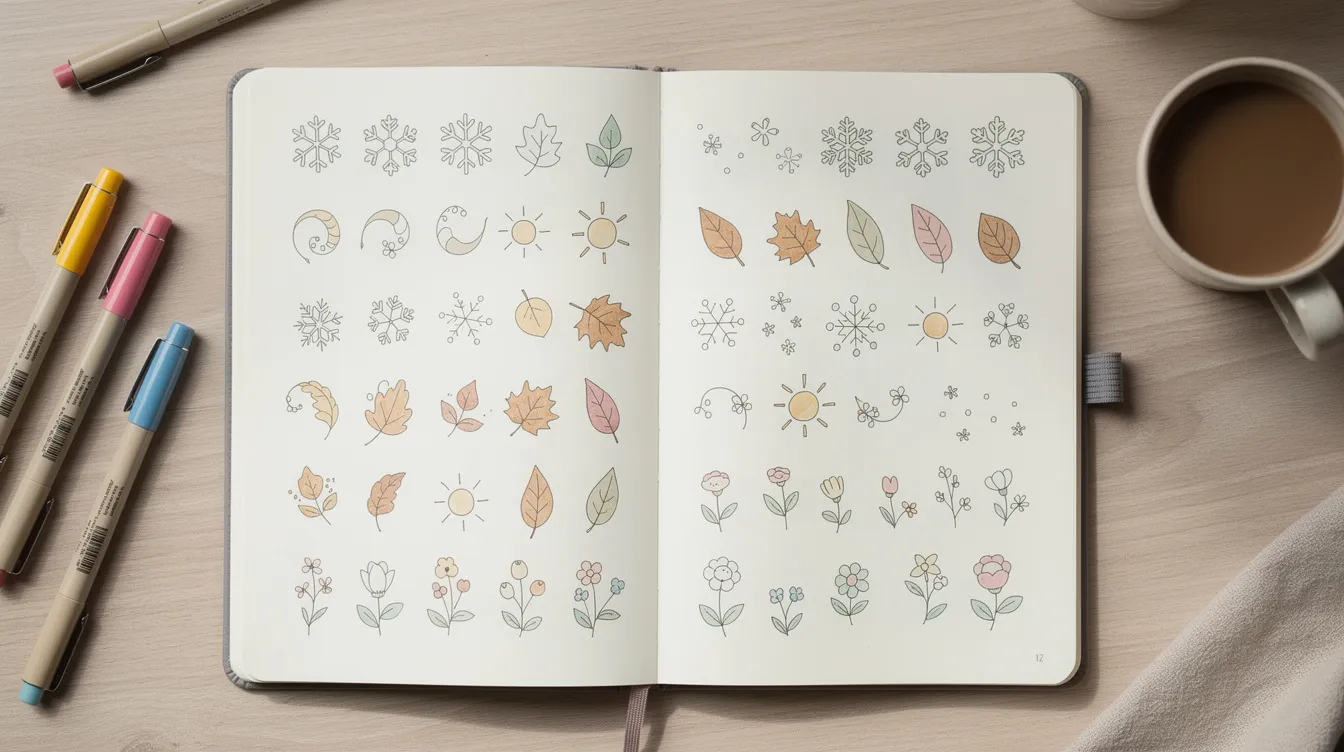
I build seasonal pages by picking two or three objects per month and repeating them in corners, headers and tracker squares. Seasonal doodles can reflect the time of year in bullet journals without requiring a full illustration. In Fremantle I use sea breeze flags in summer, a simple wave for autumn, and a banksia pod for spring.
Four clusters I rotate through:
-
Summer. Ice cream cone, beach umbrella, sunglasses, watermelon slice. Summer doodles can include beach themes and ice cream.
-
Autumn. Pumpkins, falling leaves, mushroom, acorn. Fall doodles can include pumpkins and scarecrows. I draw jack-o-lanterns for Halloween pages.
-
Winter. Snowflakes, hot chocolate mugs, reindeer head, snowman, wrapped gifts. Winter doodles often feature snowflakes and hot cocoa. Christmas doodles land on my December cover page every year.
-
Spring. Pastel tulips, cherry blossoms, bees, rain boots.
Holiday-themed doodles enhance festive bullet journal spreads, and doodle tutorials for seasonal themes are popular among users. Seasonal doodles enhance bullet journal themes and reflect the changing seasons in a way that makes flipping through old pages relaxing.
Everyday Icons: Food, Coffee, Stationery and Favorite Things Doodles
I use small icons beside text in daily logs and habit trackers. A tiny cake for birthdays, a tooth for the dentist, a pot plant for watering days, a bin for rubbish day. Pick a small set and use it consistently so appointments are faster to find. Using recognizable doodles as task icons can improve page scanning efficiency, and doodles act as visual anchors in bullet journals.
Categories I draw from:
-
Food. Cake slices, smoothie glasses, bowls of noodles. Simple, recognizable doodles can represent tasks like meal planning.
-
Coffee. Mugs, takeaway cups, coffee beans. I decided these are the sign that a page is about my morning routine.
-
Stationery. Pens, washi tape rolls, paper clips in different sizes.
A favorite things doodling page is a happiness boost. I drew my 2024 list: my comfort TV show, my favorite mug, my current snack and the succulent on my desk. Doodles can enhance habit tracking and mindfulness in journaling, turning data into pictures that are adorable to revisit. Doodles make tracking data in journals more engaging than rows of checkboxes.
Plants, Floral Doodles, and Cactus Doodles For Calm Spreads
Plant doodles are my go-to when I’m tired because they’re repetitive and soothing. Drawing the same leaf shape ten times along a border is the journaling equivalent of sitting somewhere quiet with no phone.
Simple florals to try: daisies (circle centre, oval petals), sunflowers (same but bigger), tiny five-petal flowers, and leaf borders running along a pencil line. Floral doodles are popular for bullet journals, and adding them to gratitude logs or mood trackers gives those pages a theme without extra effort.
Cactus doodles and succulents are pretty easy: draw an oval or column, add rib lines, stick a tiny flower on top. I keep a row of cactus doodles along the bottom of my February spread every year. Good spreads for plant doodles: monthly covers with wreaths, habit trackers with a leaf per day, and notes pages framed by a vine border.
Cute Characters: Animal Doodles, Birthday Doodles and Banner Doodles
I nearly always add one animal doodle a month. Often it’s my cat, sometimes a creature from a jar prompt like “a creature wearing a hat.” Beginner animals are circles and bean shapes with tiny faces: a cat is two triangles on a circle; a whale is a bean with a tail fin; a bee is an oval with stripes and two dots for eyes. Animal doodles add cuteness to bullet journals. Drawing them is fun, and they make friends smile when they flip through your notebook.
Birthday doodles for trackers and party planning pages: balloons (ovals with strings), candles (rectangles with a teardrop flame), cake slices, confetti dots, wrapped gifts. Banner doodles work as headings on any spread; draw a rectangle, add the folded ends, write the title inside. Keep each one simple so the page stays readable.
Layout Ideas: Where To Put Bullet Journal Doodles In Real Spreads
Examples from my own journal: a July habit tracker full of tiny drink doodles, a plants mood tracker where each day is a leaf coloured by mood, a reading log with doodled book covers, and dividers made by repeating one tiny shape along a pencil line.
Where to place doodles on bujo pages:
-
Corners and margins (small flowers, stars, leaves)
-
Empty boxes left by short task lists
-
Page dividers between sections; doodles can compartmentalize sections within a bullet journal
-
Title banners at the top of weekly or monthly spreads
Write first, decorate second. Mark doodle zones in pencil, and keep decoration to roughly a fifth of a page. Maintaining white space in doodling enhances readability and aesthetics. Doodles personalize bullet journal pages, but too many make the content hard to read.
Trackers are where doodles do real work: eight glasses for water, a book stack for reading, thirty-one tiny flowers for habits. Plan spacing in pencil first. I’ve ruined entire month pages by going straight to pen.
Bullet Journal Doodle Challenges and Prompt Jars
A doodling challenge gives you one prompt per day so you start drawing rather than staring at a blank page. I keep my prompts in the old pickle jar, but a list on the last journal page works just as well. The point is removing the decision.
Ideas for challenges:
-
7-day “animals” challenge (one new creature per day)
-
7-day “food week” (breakfast items, snacks, drinks)
-
30-day “weather icons” (draw the day’s weather as an icon)
Last winter I hit a drawing slump. Nothing I drew looked right and I stopped opening the notebook for two weeks. I pulled a slip that said “draw five versions of a star” and that was enough to get me back. The prompt was so low-stakes that I couldn’t fail. Explore this idea if you ever stall; sometimes the smallest challenge is the one that gets your creativity moving again.
Fixing Mistakes and Making Bad Doodles Work
Messy doodles happen in every journal, mine included. My rules: don’t tear pages out, cover with a doodle if you can, move on to the next day.
Practical fixes:
-
Turn a blot into a cloud, berry or rock
-
Cover mistakes with stickers, washi tape, or a black-out box
-
Layer banners or floral doodles over lines you dislike
-
Use a white gel pen for small corrections
In 2023 I smeared wet ink across an entire Monday spread with my palm. I let it dry, drew a row of tiny cacti along the smear and wrote “desert Monday” above it. It’s now one of my favorite pages. A journal with a few wobbles is more art than a perfect one; the details that go wrong are the ones I remember when I look back through old pages.
Building Your Own Style With Bullet Journal Doodle Ideas
Start by copying a doodle tutorial, then slowly change proportions, eyes or colours. Using the same shape three times on a page makes it look planned, even if it wasn’t. Each month I review which doodles I repeat and which I want to practise. Keep a doodle library spread by category: animals, banners, florals, cacti, weather, favorite things. That spread becomes your personal reference page and a source of inspiration when you need ideas fast.
I hope this blog post gives you enough to start doodling in your own bullet journal today. Stop earlier than you want to, because empty space is part of the layout. The life of a doodled page is in the small marks, not in filling every centimetre. Pick up whatever pencil or pen is on the table, set a timer, and draw one small thing. The next page is always blank.
FAQ
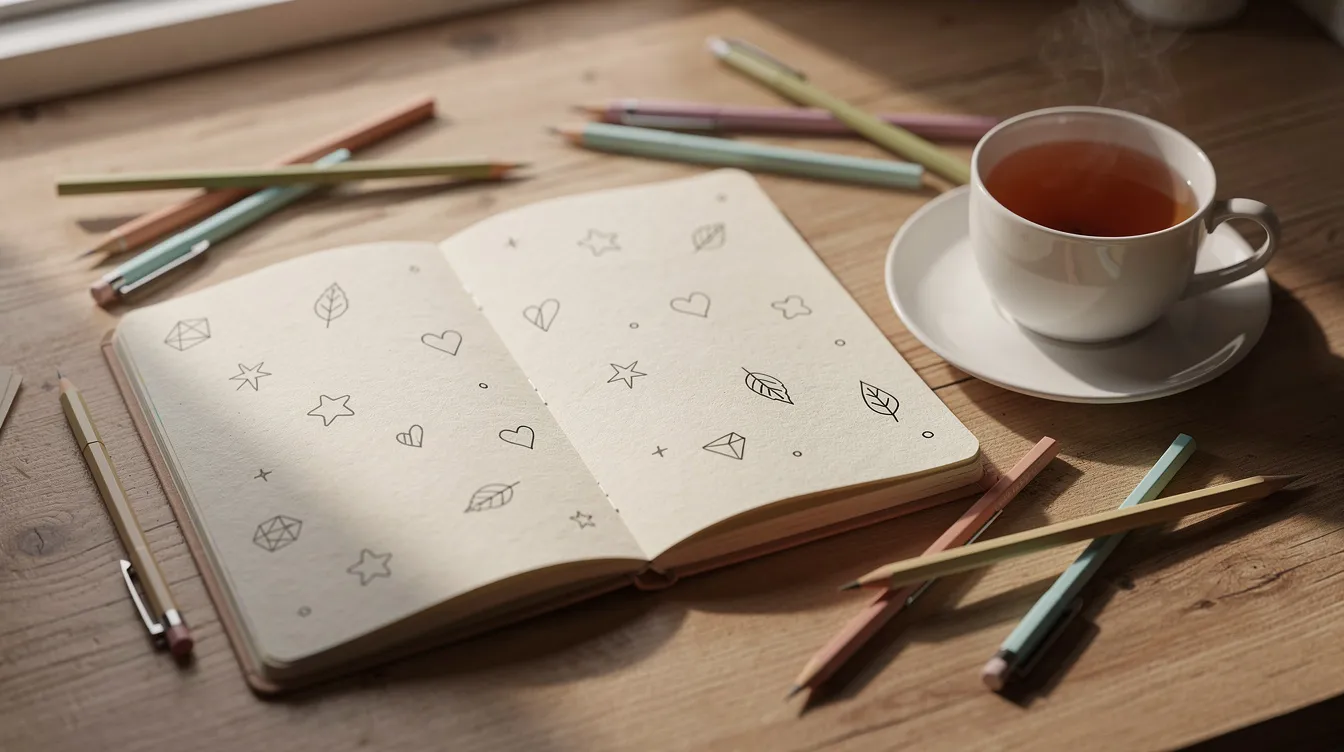
What are the easiest doodles to start with in a bullet journal? Underlines, dividers, stars, leaves, clouds and tiny icons like cups or suitcases. These are pretty easy to draw without any practice and look good on any page.
Do I need special pens for doodles? No. One black fineliner is enough. Test it for bleed-through on your notebook paper, and add a pencil for planning layouts. Colored pencils or markers are optional.
How much of a page should be doodles? Roughly a fifth or less. Keep weeklies and dailies light, and save big doodles for title pages or monthly covers.
How do I stop my doodles from taking too long? Set a limit, such as two minutes per doodle, and reuse the same motifs. No matter how cute a drawing is, if it takes ten minutes on a Tuesday log, it will slow you down.
What if my doodles look different every time? That is part of the charm. Practise one object on scrap paper and copy your favorite version into your journal. Style comes from repetition, not from getting it right the first time. Play with shapes, try pictures of the same object at different sizes, and keep the ones you like.
