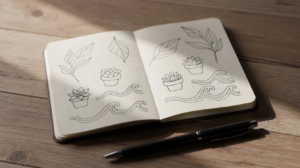
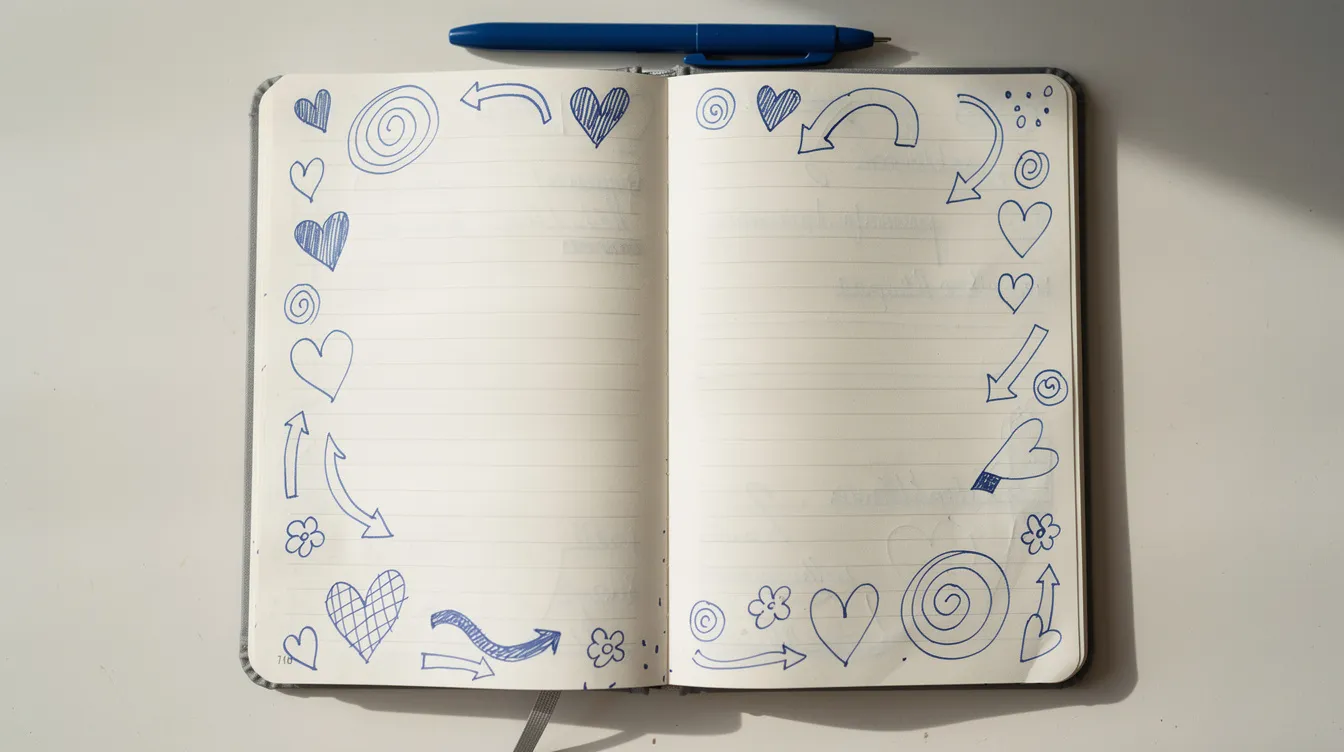
I have doodled in the margins of lab stock-check sheets in Fremantle with a ballpoint for as long as I can remember. This is what I have noticed along the way, not anything official.
What Is Doodling, Really?
Doodling is spontaneous drawing done while your attention is occupied by something else. You might be sitting through a staff meeting or waiting on hold with the school office and your pen starts making marks on whatever paper is nearest. There is no plan, no sketching stage, and nobody grades a doodle. That is why it suits people who say they can’t draw. Doodling allows for creativity without requiring artistic training, and it can include simple lines and intricate designs on the same page. Different types of doodling include geometric, floral, and abstract, and all of them count. Doodling allows spontaneous and free-form creative expression, and it requires only basic materials like paper and pens.
The usual places people doodle: notebook margins, bullet journals, Post-it notes stuck to the phone, envelopes waiting by the front door.
A few everyday examples to prove you probably already doodle:
-
Hearts and spirals along the edge of a printout
-
Boxes stacked into little towers
-
Arrows pointing nowhere in particular
-
Tiny flowers in the corner of a page
-
Circles filled with dots or lines
-
Stars trailing down a margin
What Does “Doodle” Mean And Where Did It Come From?
In modern English, a doodle is a small, unplanned drawing, often made while thinking about something else. The word originally meant a fool or simpleton back in the 18th century, and it may come from the German “dudeln,” meaning to play music in a simple, repetitive way. The shift from “fool” to “idle scribble” happened gradually, and the Wikipedia entry on doodles gives a good short history for anyone curious about that journey.
Dictionaries still describe doodling as drawing while bored or distracted. I would argue it is lighter than that. It is low-pressure, effort-free play with no goal, and it is a low-pressure activity that fosters exploration of ideas without judgement.
Three meanings of “doodle” that I find useful:
-
Scribble: rapid, automatic marks and dots on paper
-
Small drawing: a tiny icon, a flower, a shape with some detail
-
Playful habit: something you do for fun, not for a result
Why Do We Doodle? (And Why I Keep Coming Back To It)
During a safety briefing in 2021 I covered half a page in hexagons and realised afterwards that I had followed the whole talk more closely because my hands were busy. A page of stock-check numbers needed a little life beside it, so a doodle became a small private reward for a dull task. That moment stuck with me.
Here are the reasons I keep coming back, and the situations where doodling helps most:
-
Staying awake in a long Zoom call by filling a corner with circles and lines
-
Calming nerves before a presentation with repetitive patterns and waves
-
Parking racing thoughts into shapes instead of letting them spin
-
Avoiding the phone on the train by pulling out a pencil and paper instead
-
Making a boring task feel lighter because the pen gives you something private and fun
-
Processing emotions after a hard day through scribbles that express feelings you cannot name
Doodling engages the brain’s default mode network, which is the same system active during daydreaming, but in a gentler way. It can reduce cognitive load by preventing boredom-induced daydreaming and help prevent zoning out during monotonous tasks. Nearly two thirds of doodlers recall doodling during tense moments, and that makes sense to me. Doodling serves as a mental anchor to calm overactive thoughts. It activates unfocus circuits to lower psychological distress and can provide a distraction from negative thoughts. It can lower cortisol levels in the body, reduce stress and anxiety levels, and provide emotional grounding that works as quiet self-care.
Beyond mood, doodling can improve concentration and thought organization, sharpen visual thinking and problem-solving skills, and help bridge conscious and unconscious problem-solving. It can unlock creativity and generate new ideas because it encourages divergent thinking by reducing inner critic pressure. It provides a mental break from everyday stresses, and a doodle can’t be wrong, which is rare in adult life.
I should be honest about the evidence. I recall a 2009 study by Jackie Andrade where doodlers recalled slightly more of a dull recording. Doodling can boost memory and retention during information reception, and research shows doodlers recall up to 29% more information. I am a hobbyist, not a researcher, so I treat that as a small, interesting result and say your mileage may vary.
What Do You Need To Start Doodling?
You can start right now with the nearest pen and scrap of paper. Doodling can be a fun way to practice artistic skills with simple materials. Here is a basic starter kit:
-
A black gel pen or cheap ballpoint
-
A supermarket notebook
-
A pencil and eraser for gentler lines
-
Maybe one coloured highlighter
My lab-bag favourites: a 0.5 mm black fineliner, a blue biro, and offcuts of A4 trimmed from printed lab forms. My opinion: a pen you are afraid to waste makes you tense, so save the fancy ones until the habit sticks.
Optional upgrades for later: brush pens for thicker lines, a dotted journal for neat grids, a small travel sketchbook for cafe doodles.
How To Doodle When You “Can’t Draw”
Many readers of The Doodle Jar tell me they failed art at school. Doodling ignores graded results completely. There are no rules about what goes on the page. If you still can’t pick a subject, my list of random doodle ideas gives you somewhere to start.
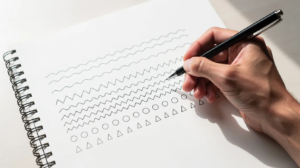
A mini-routine to begin: fill a page with straight lines, then a page of circles, then triangles, then combine them into loose abstract shapes. Or start with a few lines in a corner and echo, repeat, or cross them until a pattern appears. Doodling techniques can help improve hand-eye coordination and confidence over time, and it can improve your skills in drawing shapes and patterns. Blind contour drawing, where you look at an object without looking at the page, improves hand-eye coordination and observational skills too. Doodling can also serve as a warm-up before larger art projects. If you want a few starter subjects before you try this, my guide to easy doodles to start with is a good companion.
Quick recipes to try tonight:
-
Draw a border of tiny boxes along a margin and fill each with different textures
-
Scatter a cluster of bubbles across a page, some overlapping
-
Trail linked stars down the side of a page
-
Draw a box the size of a matchbook and repeat one shape inside it, because repetition looks deliberate
-
Stop when the space feels full, not when it looks perfect
For readers who want a walkthrough starting from circles and lines, simple doodles for beginners is a good next step to explore.
5 Simple Styles Of Doodle Art To Try
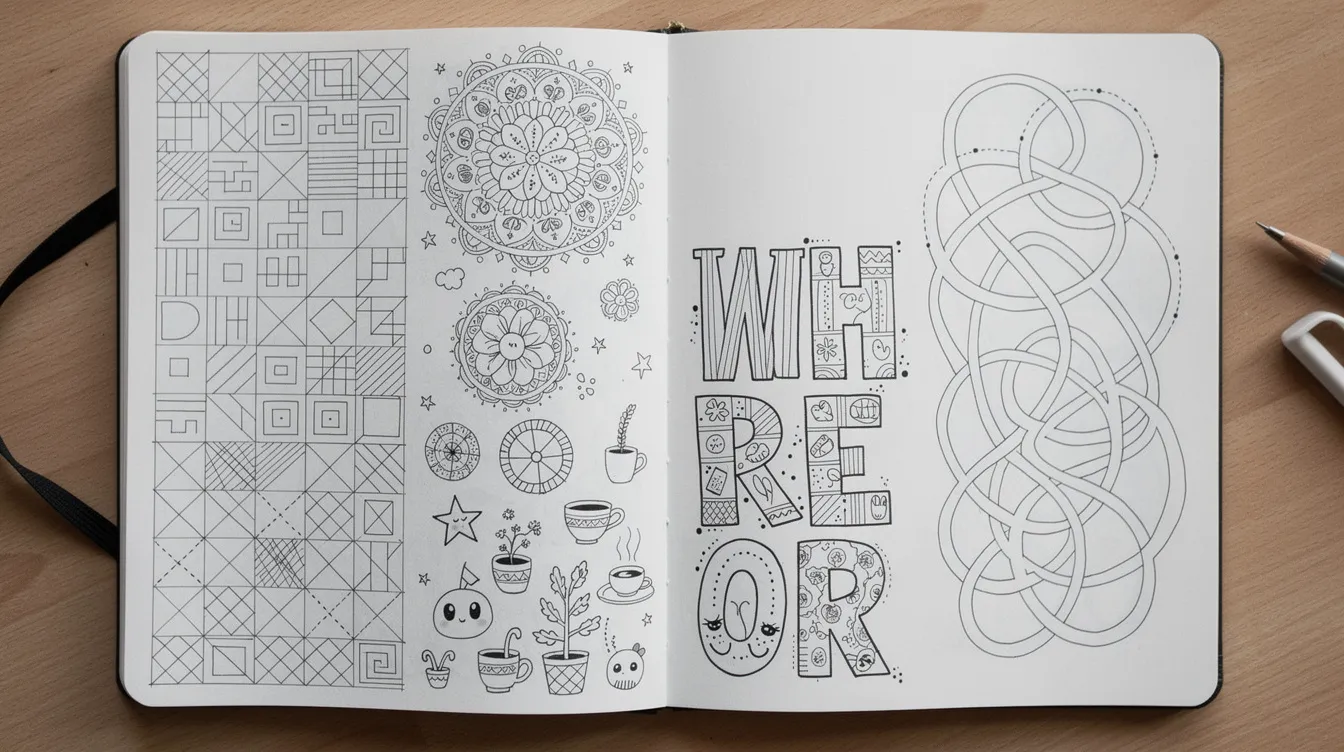
Doodle art looks different for everyone, and trying different styles is how I found the look of my pages. Here are five to experiment with: pattern grids, mandala circles, cartoon icons, word doodles, and loose abstract shapes. Pick one and give it ten minutes on a single page before jumping between them.
Pattern Grids
Draw a light grid of squares or a rectangle repeated across the page, then fill each box with one motif: stripes, dots, zigzags, checkerboard. The result looks like a quilt. This is related to Zentangle, which involves creating structured patterns within a defined space. Stippling, where you build form from dots alone, builds value control and understanding of light and shadow and fits neatly inside a grid square. Good for bullet journal margins because it stays neat and can be paused at any moment. Browse bullet journal doodle ideas for more layouts that suit this style.
Mandala Circles
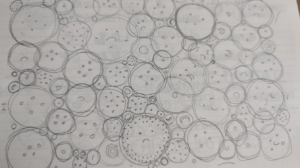
Start with a small circle in the center of the page, add rings around it, then repeat petals, diamonds, and arches. Mandala doodling features radial symmetry and geometric shapes, and it feels meditative. Use simple lines and dots first, then add more detail or colour later with highlighters or coloured pencils. Works well as a filler for a journal cover page or a quiet corner.
Cartoon Icons
Build tiny objects from basic shapes: a cup from a rectangle and a circle, a cat from triangles and ovals, a house from squares and a triangle. Add eyes, a mouth, or a head to give characters life. Cartooning doodles can help develop unique character styles over time. Build a small vocabulary of icons from daily life (test tubes for lab days, plant pots for weekends, flowers for good days). Repeating them across pages makes your journal feel like a story.
Word Doodles
Treat lettering as doodling with letters: take a word like “Tuesday” and add shadows, bubbles, banners, and stars around it. Mix block letters with different fonts or bubble letters, using lines and stripes inside each letter to add textures. Lettering involves creating decorative styles of letters and words, and it is useful if you hate your handwriting. Writing a name over and over until it becomes a pattern is my favourite trick. You can freely play with coloring inside the letters to pop the shapes off the page.
Loose Abstract Shapes
Let the pen wander in a slow looping line across the page, then divide the big form into sections and fill some with patterns, leaving others blank for breathing space. Continuous line art fosters line confidence and encourages planning even when the result looks wild. This style is ideal when you feel restless or overwhelmed, because it asks for movement first and decisions later. Use your imagination to discover what the shapes remind you of: landscapes, elements of the natural world, or just pure emotion without meaning.
Doodling In Journals, Margins, And A Doodle Prompt Jar
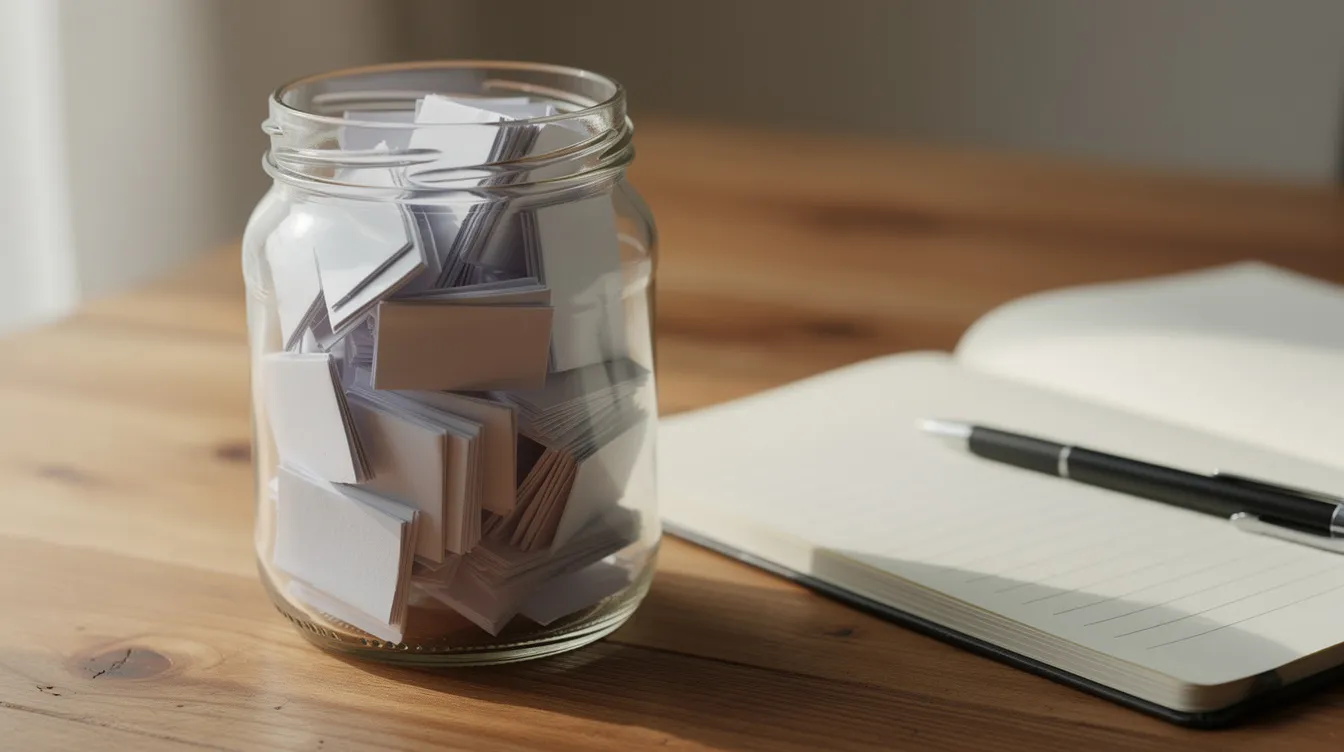
Two years ago an old pickle jar became “The Doodle Jar,” filled with folded prompts like “a mug with something odd in it,” “ten ways to draw a leaf,” or “fill the page with circles.” Prompts take the pressure off deciding what to draw, which is where most people stall.
-
Journals: repeating-leaf borders, habit tracker frames made of little boxes, mood trackers with simple icons. A smudged line becomes a flower stem and a crooked box becomes a banner.
-
Work papers: fill the edge of a meeting printout with waves, triangles, or tiny flasks while listening. Nobody needs to see them.
-
Make your own jar: cut scrap paper into strips, write short prompts (objects, abstract ideas, shapes, challenges), fold them, and drop them into any clean jar. Pull one when a blank page stops you.
For readers who want more ideas for planners and trackers, doodles for a bullet journal is a good place to look next.
Using Doodling To Fix “Ruined” Pages And Keep Going
I once splattered coffee across a journal spread and sat there staring at the stain. Instead of tearing the page out, I turned the splatter into a cluster of abstract shapes with a black pen. It looked deliberate. It was not, but nobody else would know.
Rescue strategies that work for me:
-
Cover mistakes with black boxes filled with white gel pen patterns
-
Turn spelling errors into banners
-
Hide smudges under flowers or petals
-
Turn a lopsided circle into a pebble, balloon, or moon
-
Fill awkward gaps with geometric shapes or a trail of stars so the page feels deliberate
-
Or just leave it, because a messy page still counts as a page you made
Messy pages are part of a living journal. Doodling over the broken bits teaches flexibility more than perfection ever will. Doodling can reduce stress and improve concentration even on a page you thought was ruined.
Pick one messy page tonight, add three small doodles, then close the book without judging it. That is the whole process. That is enough.
FAQ
Is doodling the same as drawing?
Not quite. Drawing usually has a goal and a plan. Doodling is looser and happens while you are doing something else. The tools are the same, so the line between them is blurry, but the act of doodling carries less pressure.
Do I need to be good at art to doodle?
No. Simple shapes, repeated patterns, and tiny objects are enough. They improve with practice, not talent. You do not need any formal skills to create something worth keeping.
Does doodling during a meeting or class mean I am not paying attention?
Not necessarily. A moving pen helps me stay with what I am hearing and keep my focus on the speaker. One small 2009 study reported something similar. Notice what works for you and forget what anyone else thinks about it.
What is the best pen for doodling?
The one you are not precious about. A cheap black fineliner or ballpoint is plenty. Fancy materials can wait.
How long should I doodle for?
As long as you feel like. I often do five minutes while the kettle boils, and a small regular amount beats waiting for a big block of time. Even that brief moment is enough for your brain to stand down from the noise of the day and let new ideas pop up on paper.